REVIEW · VALENCIA
Valencia Old Town Guided Tour
Book on GetYourGuide →Operated by alapontasins.com · Bookable on GetYourGuide
Valencia’s Old Town comes at you fast, with photos, stories, and landmarks. I like how this tour connects the dots between the city’s past and the streets you’re walking today, and I also like the small group size (10 max), which makes it easier to ask questions. One thing to consider: some of the most famous spots (like the Silk Stock Exchange and a couple of key interiors) have entry tickets not included, so you may need to plan around that if you want inside views.
You’ll start at Estació del Nord and spend about 2.33 hours covering the classic highlights: markets, squares, old gates, and baroque architecture. The route also pays special attention to Valencia’s March rhythm, including the Fallas connections around Town Hall Square and Serranos Street.
If you want a relaxed shopping finish, this tour is set up for that too. It ends in the Colón Market / Colón shopping zone, where you can slow down for a coffee and an easy break—perfect if you’re not trying to sprint through everything.
In This Review
- Key highlights you’ll care about
- Meeting at Estació del Nord: the easiest way to start strong
- How the tour turns streets into stories with old photos and videos
- Town Hall Square and the Post Office façade: the March Fallas connection
- Pedestrian street time: traditional clothing shops on your route
- Central Market and Silk Stock Market: trade power in 15th to 20th century scale
- The Old Town’s 3 diamonds: Doctor Collado, Lope de Vega, and Round Square
- Queen Square and Virgin Square: where the city’s origins show up
- Serranos Street and Serranos Towers: the old entrance gate energy
- L’Almoina archaeological center: birthplace of the city (tickets not included)
- Paz Street and the Palace of Dos Aguas: power, art, and ceramics
- Colón and Don Juan de Austria shopping finish: coffee, horchata, and picture time
- Price and value: what you get for about $28
- Guide style: why a small group matters (and Enrique is a good sign)
- Who should book this Valencia Old Town tour?
- Should you book this Valencia Old Town guided tour?
- FAQ
- How much does the Valencia Old Town Guided Tour cost?
- How long is the tour?
- Where do I meet the guide?
- Where does the tour end?
- What’s included in the price?
- Are entry tickets to major sights included?
- Is the tour wheelchair accessible?
- How big is the group?
- What languages is the guide available in?
- On which dates is the tour not available?
Key highlights you’ll care about
- Estació del Nord meeting point: clear, landmark-based start under the station’s flags (and easy transit access).
- Old photos and video time: you get context before you hit the streets, so the city makes more sense.
- Central Market + Silk Stock Exchange area: two major buildings tied to Valencia’s trade power across centuries.
- The Old Town’s 3 diamonds: Doctor Collado Square, Lope de Vega Square, and Round Square in one walking loop.
- Serranos Gate welcome vibes: Serranos Street and Serranos Towers, closely linked with Fallas energy.
- Finish at Colón Market: you end in the shopping streets of Colón and Don Juan de Austria.
Meeting at Estació del Nord: the easiest way to start strong
Your guide meets you at the central tower of Norte train station (Estació del Nord), under the Valencian, Spanish, and European flags. This is a great meeting point because it’s hard to miss, and it anchors the tour in the kind of place locals actually use every day.
You’ll also appreciate the transit practicality. The station is close to the bullfight arena, and it’s easy to reach using the Xàtiva bus stop and subway station, with the exact stop listed as Xàtiva-Renfe.
From a planning standpoint, that matters. Getting started smoothly means you’ll spend more time walking the Old Town and less time hunting your group.
You can also read our reviews of more guided tours in Valencia


How the tour turns streets into stories with old photos and videos
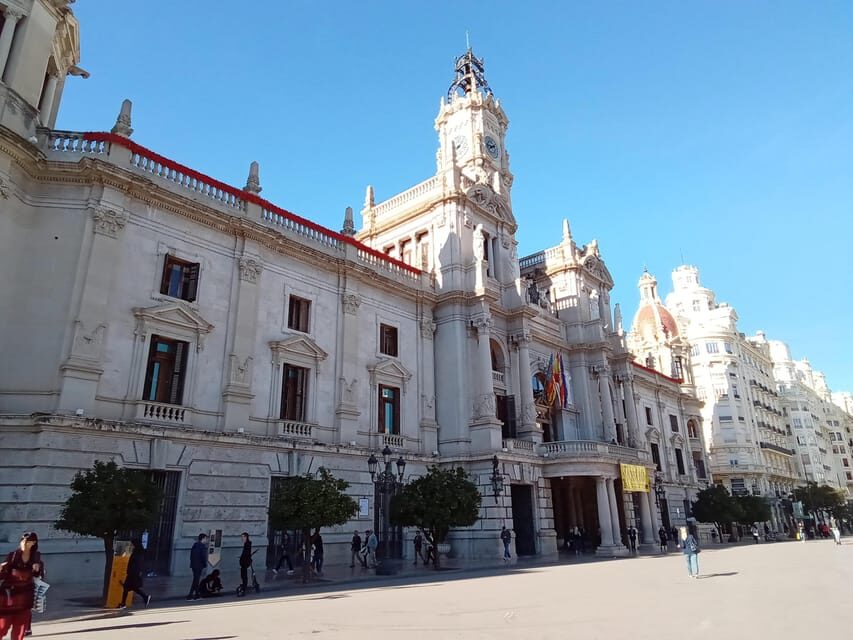
This isn’t just a checklist of landmarks. The tour includes old pictures and videos that explain how Valencia evolved, so when you see a square, a market, or a gate, you’re not guessing what role it played.
That approach is especially useful for first-timers, because Valencia’s Old Town can feel like a mix of eras stacked on top of each other—Roman roots, medieval gates, and later grandeur all in the same walk. With the visual context, the city clicks faster.
And one more detail I genuinely like: guides keep the flow practical. You’re walking pedestrian streets, and there’s room to move at a human pace while still covering a lot.
Town Hall Square and the Post Office façade: the March Fallas connection
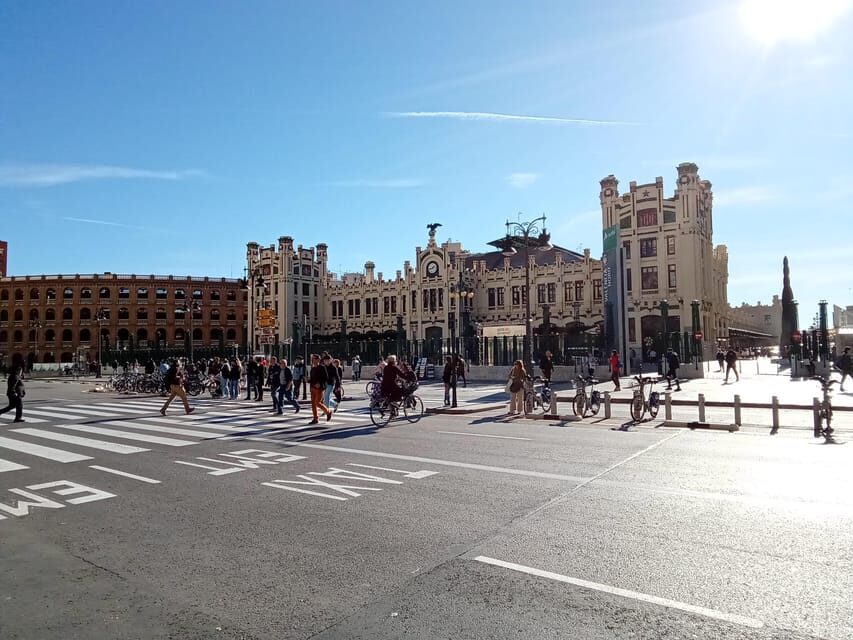
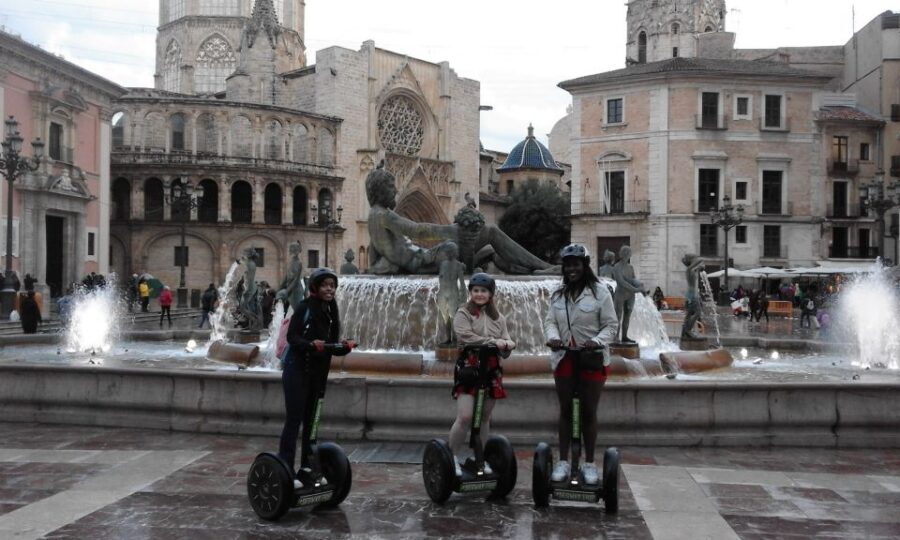
If you’re in Valencia around mid-March, this stop adds meaning beyond sightseeing. The Town Hall Square and the façade of the Post Office are described as a monthly highlight in March during the Fallas festivities (which run 15th to 19th March).
So what does that change for your experience? It means you’re seeing architecture with a calendar attached. Fallas isn’t just fireworks and crowds—it’s a citywide tradition that touches public buildings and street spaces. Even if your dates are not exactly peak Fallas, the tour helps you understand why these places matter.
One important note: the activity is not available on 17th and 18th March. If your trip lands those days, you’ll need an alternate plan.
Pedestrian street time: traditional clothing shops on your route
You also get time walking along pedestrian streets where you can browse and spot traditional Valencian clothing stores. This is a nice change from tours that only race between big monuments.
Even if you don’t plan to buy anything, this part helps you see what the Old Town still does in daily life: commerce, style, and local identity. And if you do want to shop, this is the moment—before you’re tired and before your energy is gone.
Central Market and Silk Stock Market: trade power in 15th to 20th century scale
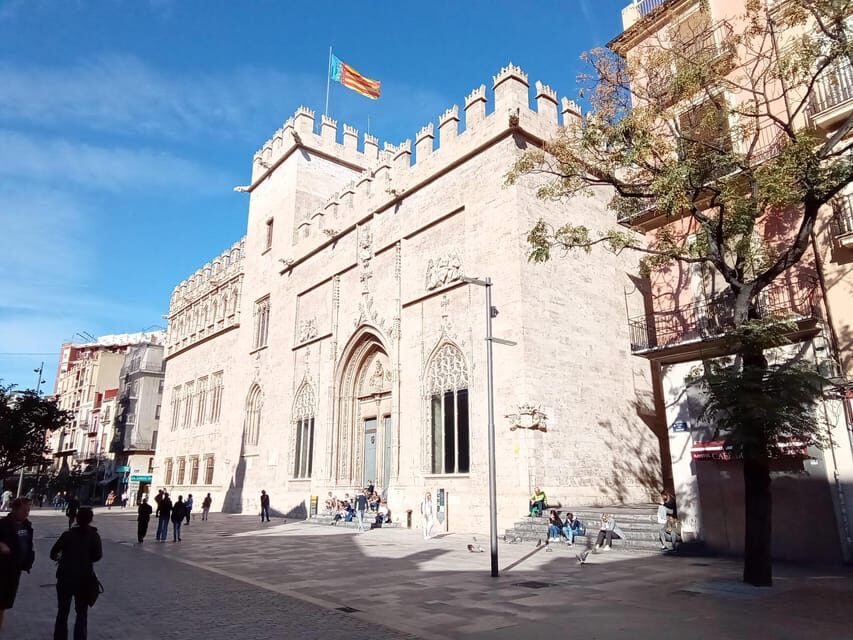
Two of the tour’s big “wow” areas are the Central Market and the Silk Stock Market (Silk Exchange). They’re framed as key buildings from the 15th and 20th centuries, which is a huge clue to what you’re looking at: Valencia’s wealth wasn’t just art and cathedrals—it was also organized trade.
In practical terms, here’s what you’ll likely get out of this segment:
- a clear sense of why these buildings are important
- orientation inside the market complex areas and nearby streets
- enough structure that you don’t feel lost when you spot these icons
One catch: entry tickets are not included for the Silk Stock Exchange and the Archeological Center l’Almoina, plus the Palace Marquis of Dos Aguas. That doesn’t mean the stops are useless—far from it. But if you specifically want to go inside for the full experience, you’ll need to budget separately.




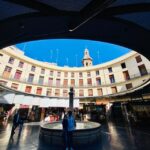
The Old Town’s 3 diamonds: Doctor Collado, Lope de Vega, and Round Square
The tour highlights the “3 diamonds” of the Old Town: Doctor Collado Square, Lope de Vega Square, and Round Square. This is one of those descriptions that sounds cute, but it’s actually a helpful way to remember the route.
Squares are more than visual breaks. They’re where people gather, where routes converge, and where the city shows how it wants you to move. When you hit these three in sequence, you start noticing patterns: sightlines, building forms, and how the Old Town shapes pedestrian flow.
If you like walking tours that teach you how to read a city, this part is a strong payoff.
Queen Square and Virgin Square: where the city’s origins show up
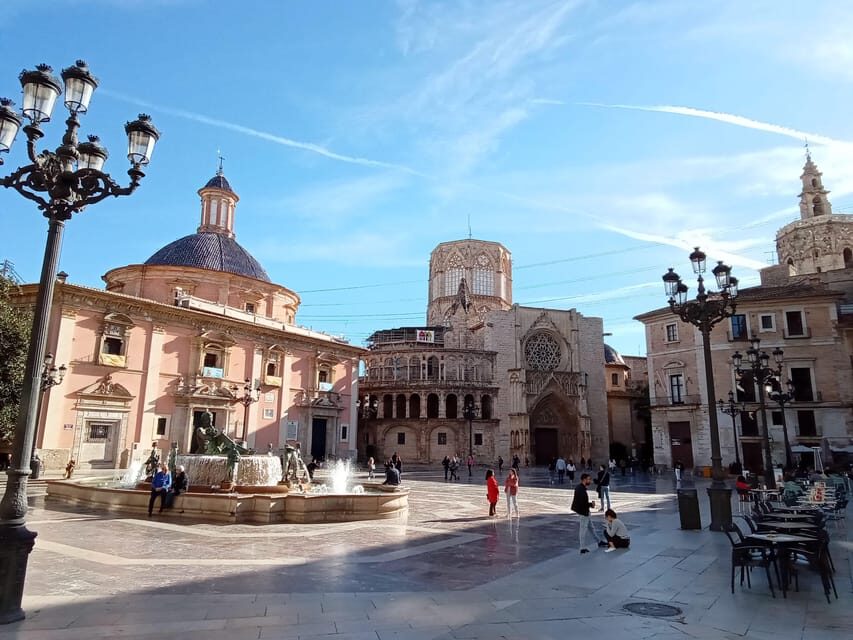
Near the tour’s core origins, you’ll visit Queen Square and Virgin Square—presented as the starting point of the city along with Roman Valentia and the Water Tribunal.
This is a smart inclusion because it gives you an anchor. Many Old Town walks bounce between big sites without explaining the “why” of where everything began. Here, you get a roadmap: Roman roots, governance traditions tied to water management, and public identity.
If you want one practical tip for this area: slow down. Origin-squares often feel similar at first glance, but the tour’s framing helps you notice differences that you might otherwise skip.
Serranos Street and Serranos Towers: the old entrance gate energy
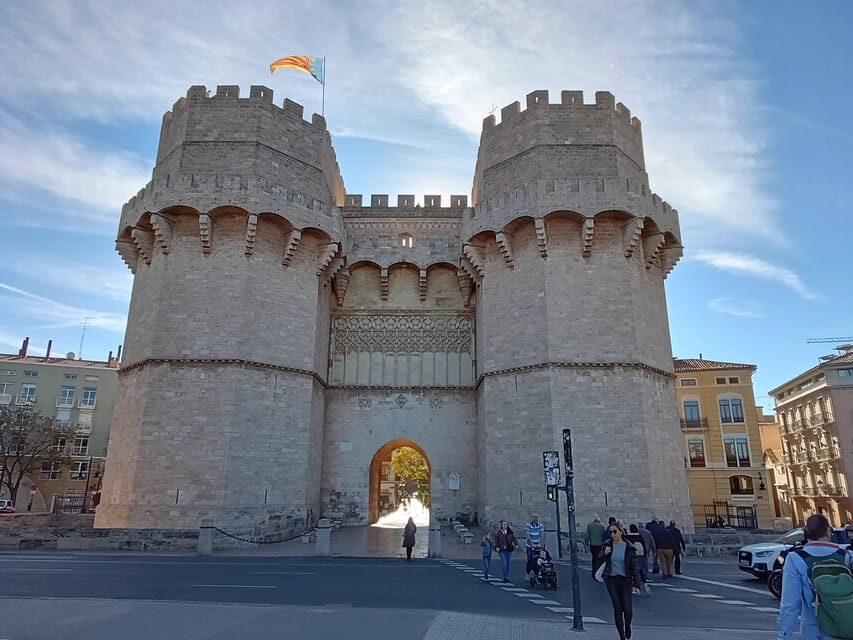
Next up is Serranos Street and the Serranos Towers, described as the old entrance gate to the city and the welcome point of the Fallas festivities.
This matters for two reasons:
- Gates are where a city transitions—outside to inside, approach to entry.
- When a tradition like Fallas ties to the entry point, the location becomes part of the storyline, not just a wall.
So even if you’re not there during peak Fallas, you’ll walk through the space with a clearer sense of what the city is doing here.
L’Almoina archaeological center: birthplace of the city (tickets not included)
The tour includes Archeological Center l’Almoina, described as the birthplace of the city. That’s a major historical claim, but it’s also an easy one to understand once you’ve been led here: it’s the kind of stop that can turn “Valencia is old” into something more specific.
Because entry tickets are not included, you might spend this time viewing and learning from the outside-orientation and guide explanation, rather than doing the full interior visit. If l’Almoina is a must for you, plan to add the ticket separately.
Paz Street and the Palace of Dos Aguas: power, art, and ceramics
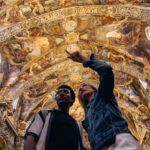
One of the most visually striking inclusions is Paz Street and the baroque Palace Marquis of Dos Aguas. The tour frames it as a building showing power, art, and ceramic heritage.
Even without stepping inside, this stop tends to land well because it’s baroque in the literal sense: decorative, confident, and designed to impress. If you care about architecture beyond churches and cathedrals, this is one of the best “Valencia has style” moments on the walk.
Also, because ticket entry for the palace is not included, treat it as a strong exterior-and-context stop unless you’re willing to purchase an additional entry.
Colón and Don Juan de Austria shopping finish: coffee, horchata, and picture time
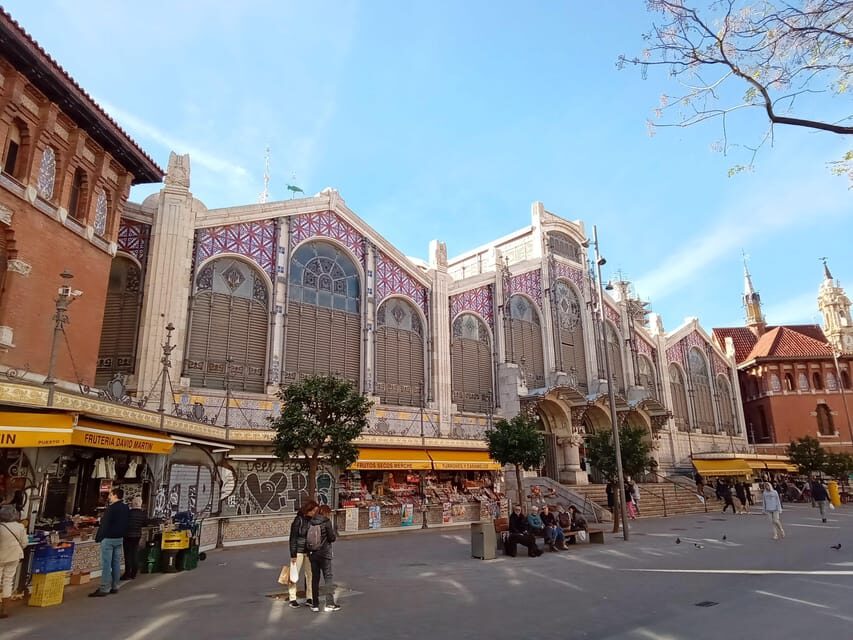
The tour ends in the shopping streets of Colón and Don Juan de Austria, finishing at Mercado de Colón. This is a practical way to wrap things up: you’ve spent the morning-to-afternoon learning and walking, and then you land in an easy place to take a breather.
The tour description explicitly suggests you can sit down, relax, have a coffee, or enjoy traditional Valencian horchata, and upload photos while you still feel good.
One small planning note: the information you’re given says the tour finishes at Mercado de Colón, but it also states that the activity ends back at the meeting point. Since the two details can appear contradictory, I’d recommend you confirm the exact end location when you book—especially if you’re connecting to another reservation right after.
Price and value: what you get for about $28
At around $28 per person, this feels like solid value for a few reasons:
- You’re paying for a live guide and a structured route that covers major sites in roughly 2.33 hours.
- You get context tools (old photos and videos), not just movement from A to B.
- It’s small group (10 max), which usually means fewer “everyone, follow me” moments.
What you’re not paying for are the entry tickets to the Silk Stock Exchange, l’Almoina, and the Palace Marquis of Dos Aguas. So the best value is for people who are happy to learn from guided stops and then decide later whether they want to add specific interiors.
If you want maximum “inside time,” plan your day with extra time and separate ticket budget.
Guide style: why a small group matters (and Enrique is a good sign)
The tour has a strong guide component, and the feedback you’re likely to see centers on guides such as Enrique—friendly, with lots of interesting information, and able to connect many sights into one coherent walk.
That’s exactly what you want in a compact Old Town route. In a small group, you can hear explanations better, and the guide can keep the route flowing without feeling like you’re a number in a crowd.
Also, the tour runs in English, Spanish, German, and Italian, so it’s easier to match your language needs than with tours that only run a single option.
Who should book this Valencia Old Town tour?
This tour is a strong fit if you:
- want a guided route that covers markets, squares, and gates without endless detours
- like history told through the street scene (photos and evolution stories)
- prefer a small group and a manageable walking pace
- are planning a trip in March and want to understand Fallas connections around key public spaces
It may be less ideal if:
- you’re only interested in interior museum-style visits (since several entries are ticketed separately)
- you need a very short tour (the time is about 2.33 hours)
- you’re outside the listed age suitability (not suitable for people over 95 years)
Should you book this Valencia Old Town guided tour?
Yes, if you want a focused Old Town walk that gives you real orientation fast. For about $28, you’re getting a structured route with a small group, plus context through old photos and city evolution—exactly what helps Valencia feel less like a blur and more like a place with a story.
Book it especially if you’ll enjoy mixing architecture with markets and squares, and if you’re comfortable handling any major interior stops (Silk Exchange, l’Almoina, Dos Aguas) with separate tickets.
If you want a “best of Valencia” day without overplanning, this is a practical way to do it.
FAQ
How much does the Valencia Old Town Guided Tour cost?
It costs $28 per person.
How long is the tour?
The guided walk is listed as about 2.33 hours, and it’s also described as a 2-hour walking tour.
Where do I meet the guide?
Meet at the central tower of Estació del Nord (Norte train station), under the Valencian, Spanish, and European flags. The exact stop is listed as Xàtiva-Renfe.
Where does the tour end?
It’s listed to finish at Mercado de Colón, in the Colón shopping area. The activity information also says it ends back at the meeting point at Estació del Nord, so it’s smart to confirm the exact end point with the provider when booking.
What’s included in the price?
You get a guided walking tour and a tour guide.
Are entry tickets to major sights included?
No. Entry tickets are not included for the Silk Stock, Archeological Center l’Almoina, and the baroque Palace Marquis of Dos Aguas.
Is the tour wheelchair accessible?
Yes, it’s listed as wheelchair accessible.
How big is the group?
It’s a small group limited to 10 participants.
What languages is the guide available in?
The live tour guide is available in English, Spanish, German, and Italian.
On which dates is the tour not available?
It’s not available on 17th and 18th March.