Valencia is big; a tuk tuk helps. This is a fast, open-air way to get an overview of the city’s best-known landmarks, mixing Gothic gates, modern architecture, and the sea in about 1–2 hours. I especially love the small-group feel and the way the ride gives you an easy “see it all” plan without the usual walking grind.
Two highlights for me: the Serrano Towers area (with a clear medieval-walls backstory) and the mix of both “old city” and “new Valencia” stops, including the City of Arts and Sciences plus the Central Market zone. One thing to consider: it’s an open-air ride, so hearing can be tough when traffic is loud, and upward views can be limited by the vehicle’s covering.
In This Review
- Key things to know before you go
- Why an open-air tuk tuk is smart for Valencia
- Meeting point and timing: how to start smoothly
- Serrano Towers: medieval gate drama in real stone
- Sea Gate and the bridge that changes every season
- Mestalla stadium: Valencia’s football energy from the outside
- Old Port, Veles e Vents, and the working-harbor vibe
- Malvarrosa and Las Arenas: two beach flavors with easy access
- City of Arts and Sciences: modern icons with instant impact
- Central Market: where architecture meets everyday food
- Bullring and Estación del Norte: architecture you can spot fast
- Quart Towers: the medieval gate finish that clicks everything together
- Price and value: is $32.44 worth it?
- What I’d watch out for on the day
- Who this tuk tuk tour fits best
- Should you book this Valencia tuk tuk tour?
- FAQ
- How long is the Valencia tuk tuk tour?
- What’s the price per person?
- Is the tour offered in English?
- Where does the tour start and end?
- What’s included in the price?
- Can I cancel for free?
Key things to know before you go
- A quick highlights loop across major Valencia landmarks, with plenty of photo chances
- English-speaking guiding (plus other languages listed) with active Q&A and friendly drivers
- Open-air touring that’s easier in heat than walking, especially on shorter trips
- Serrano Towers + Quart Towers bring the medieval-gate story to life, not just architecture photos
- Sea + port stops that help you understand where Valencia’s daily life happens
- Central Market and Estación del Norte give you strong architecture hits in a short time
Why an open-air tuk tuk is smart for Valencia
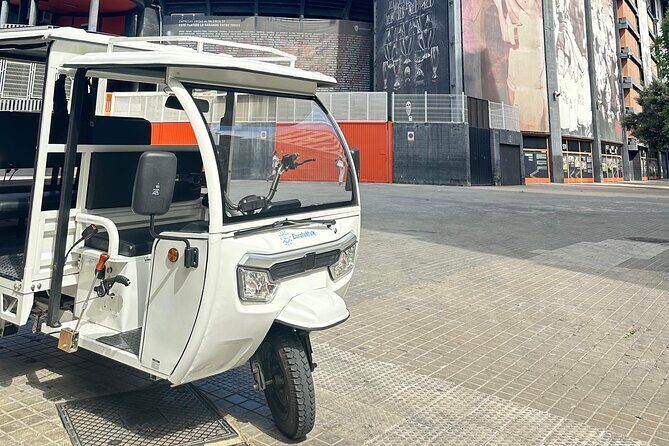
Valencia has a lot going on, and it spreads out. Doing this by tuk tuk makes sense when you want highlights in limited time, especially if your feet are already tired from beaches, day trips, or museum hopping.
The ride is open-air, so you get constant sightlines and a breeze when the weather is warm. It also keeps you moving through areas where cars and buses can feel less convenient, which is a big part of why people love this style of tour.
The tradeoff is simple: street noise is real. On busy roads, it can be hard to hear every word, so don’t count on catching every detail when traffic gets loud.
You can also read our reviews of more tours and experiences in Valencia.



Meeting point and timing: how to start smoothly
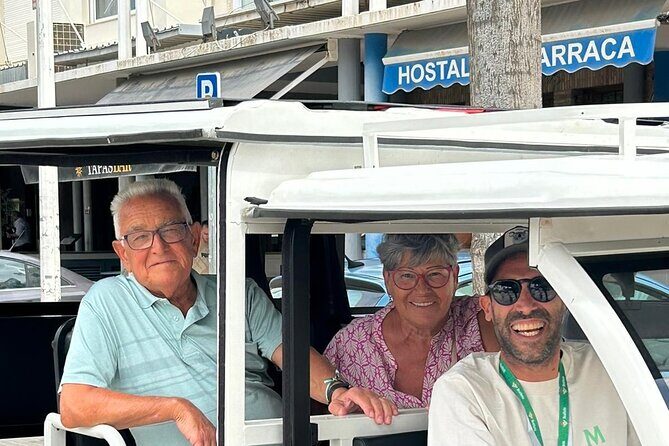
The tour starts at C. de la Blanqueria, 3, Ciutat Vella, 46003 València. It also ends back at the same spot, so you’re not scrambling to get yourself across town afterward.
This matters because you’ll feel the speed of the tour right away. A few reviews mention people having trouble locating the meeting area, so I’d suggest you give yourself a buffer and arrive early enough to confirm you’ve got the right group.
Duration is listed as about 1 to 2 hours, and the experience is described as a short loop. In practice, that means you’ll want to be ready for a “look, learn, photo, move” rhythm rather than long museum-style pacing.
Serrano Towers: medieval gate drama in real stone
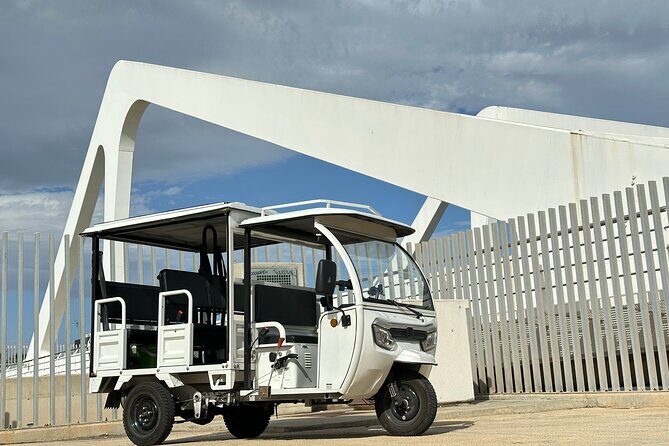
Your route begins near Valencia’s medieval wall story at the Serrano Towers. These Gothic towers date to 1392–1398, built by architect Pere Balaguer, and they originally served as a defensive gate and city entrance.
What makes this stop good is the clarity of the setting. You’re not just looking at pretty architecture—you’re seeing how a real border was built into the city’s daily movement. The description of the towers’ two polygonal flanking towers and a central arch helps you understand what you’re seeing as more than a postcard.
The towers have served as defense, prison for nobles, and later as a historical monument. You can also explore the interior and climb for views, though the tour itself doesn’t state what’s included beyond the stop—so treat any climb or interior visit as “optional on your own time.”
Practical note: this is one of the best places to stop if you like architecture with purpose. You’ll come away knowing why it was built, not just that it exists.
Sea Gate and the bridge that changes every season
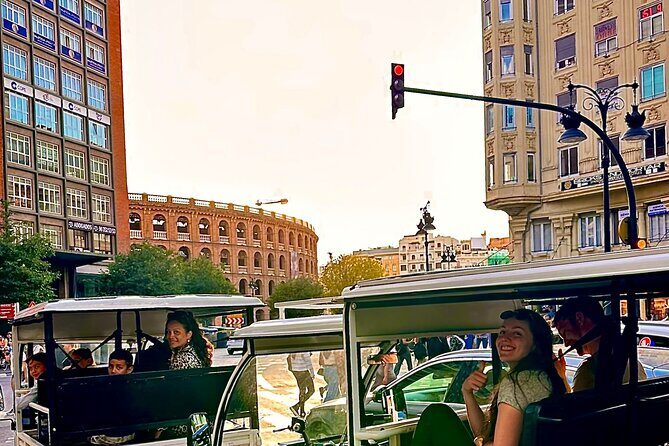
Next up is the Sea Gate, which is a modern reconstruction honoring the fallen after the Spanish Civil War. It’s made of white stone and has three arches, with the central arch the largest.
This is a short but meaningful contrast: medieval walls and then a 20th-century memorial version of the city’s connection to the sea. It’s a reminder that cities rebuild their symbols over time.
Then you get a look at a famous bridge built to give an extra step over the Turia Gardens. This one is known for changing flowers every few months, earning the nickname of the most expensive bridge in Valencia. The timing point is worth knowing: during some months the flowers are less impressive, so you might see it in its “not at peak bloom” moment depending on when you arrive.
If you’re visiting outside spring, don’t stress. Even when the flower look is less strong, the bridge still reads as a clever part of the Turia’s design.
Mestalla stadium: Valencia’s football energy from the outside
The tour then heads toward Mestalla, home of Valencia CF. It opened in 1923, seats about 50,000, and is known for steep stands that bring fans close to the pitch—so even from the outside, it signals how loud and intense match days can get.
The key value here is perspective. If you’ve only ever seen football stadiums in your hometown or in bigger cities, Mestalla feels different because of the “fans-on-top” design style and the stadium’s emblematic role in Valencia.
Since the details provided focus on architecture and capacity, don’t assume a stadium tour. Instead, think of it as a quick culture stop that helps you understand what locals care about.


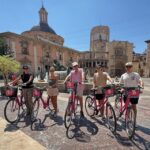


Old Port, Veles e Vents, and the working-harbor vibe
Next comes the old port, described as occupying around a million square meters and packed with activities—culture, business, gastronomy, sports, music, and entrepreneurship.
Two standout pieces of that port area are Veles e Vents and the Tinglados/old shipyard zone. Veles e Vents is noted for its unique architecture and hosting exhibitions, dance events, and arts. The shipyard area is described as a hub with sports clubs and sailing-style activities, with over 800 private moorings.
This is one of the stops I’d pick even if you’re not a “port person.” It helps explain Valencia beyond historic center walls: this is where people actually live their day—rowing, diving, kayaking, eating, and attending events.
Also, it’s a good photo zone because you get a mix of architecture styles and open sky.
Malvarrosa and Las Arenas: two beach flavors with easy access
Valencia’s beaches are a big part of its identity, and the tour covers two: Malvarrosa and Las Arenas.
Malvarrosa is described as the most famous beach and noted as having inspired artists. It used to be a flower area in the mid-1800s and later became the beach we know today. What you’ll likely notice here is how wide and walkable it feels, with easy access back to town—so it’s not only for tourists.
Las Arenas gets its name from the old fishing quarter and locals still call it Las Arenas. The old spa is now a luxury hotel complex, but the tour’s description also points out the practical reality: this area has restaurants and entertainment, and some seaside spots turn into nightlife.
A useful tip: an open-air ride makes beach stops feel refreshing after heat. But if it’s windy, it can get cool even on warm days, so I’d keep a light layer handy.
City of Arts and Sciences: modern icons with instant impact

Then you reach the City of Arts and Sciences, a major architectural and cultural complex associated with Santiago Calatrava and Félix Candela. Construction started in 1996 and ended in 2009, with the goal of revitalizing the city and positioning it as a global cultural and scientific destination.
This is where your brain goes into “wow” mode fast. Even without doing any ticketed visits, the sheer scale and shape of the buildings makes it hard to treat this as just another stop.
If you’re short on time, this is still a worthwhile moment because it gives you a clear Valencia contrast: Gothic stone gates and then bold futuristic design in the same day.
Central Market: where architecture meets everyday food
The tour includes the Central Market of Valencia, one of Spain’s oldest markets with modernist architecture. It opened in 1928, designed by Francisco Guardia and Alejandro Soler, with a large iron and glass dome, colorful ceramics, and ornate details.
This is the type of stop that helps you “read” a city. Markets aren’t only for buying food—they show what locals value: fresh produce, craft, and daily rhythms.
Also, it’s a useful navigation point. The market is noted as being close to other highlights like La Lonja and Plaza del Ayuntamiento, so even if your time inside is limited, you can build your next plan around it.
The tour description doesn’t promise a long shopping session, so if you want a sit-down meal or a proper market crawl, treat this stop as an introduction and then decide what you want to do after.
Bullring and Estación del Norte: architecture you can spot fast
Two big “visual anchors” show up here: the Bullring and Estación del Norte.
The Bullring is a neoclassical landmark opened in 1859, designed by Sebastián Monleon. It seats about 10,000 and is described as a circular brick structure with Doric columns inspired by the Roman Colosseum. It now hosts cultural events and concerts, so it’s not only about bullfighting.
Then you hit Estación del Norte, a modernist train station opened in 1917 and designed by Demetrio Ribes. It’s famous for colorful ceramics and ornamental details. The description also calls out an interior lobby that feels like something you’d see in movies.
This combination works well on a tuk tuk because both are easy to recognize from outside, and you don’t lose time walking between them. They also give your day a nice balance: one arena-like public space and one transport hub with artistic detail.
Quart Towers: the medieval gate finish that clicks everything together
The tour’s route ends with the Quart Towers, medieval city gates built between 1441 and 1460. They were part of Valencia’s defensive wall, located on the road connecting Valencia with the west and north.
The towers are robust and described as two cylindrical towers linked by a wall and a large arch. They’re brick with Gothic elements, and they were damaged during the War of Independence before being restored in the 19th century.
What I like about ending here is that it loops your day back to the start. You begin with the Serrano Towers and end with another gate—so by the time you reach Quart, you’re comparing two versions of the same idea: protection, movement, and identity built into stone.
Price and value: is $32.44 worth it?
At $32.44 per person for about 1 to 2 hours, you’re paying for speed, orientation, and low-effort movement. The tour includes bottled water (1 bottle per person) and an English guide (and guides listed in other languages too). Tips are not included.
Here’s the value calculation I’d make: you’re packing a lot of major zones into one short outing—medieval gates, the sea, the port, beaches, the City of Arts and Sciences, a famous market, and architectural landmarks like the bullring and Estación del Norte.
If you’re only in Valencia for a few days, this can save you from the “we spent half the day getting from place to place” problem. If you have plenty of time and love walking, you might prefer doing these sites slowly by foot. But if your goal is highlights and efficient city orientation, the price looks fair.
One practical note: group discounts are mentioned, and the tour limits the group to a maximum of 12 travelers. That small size tends to keep the experience from feeling like a chaotic bus line.
What I’d watch out for on the day
There are a few tradeoffs that show up in the real-world experience.
First, the tuk tuk is open-air, so traffic noise can make it harder to hear commentary at points. If you care about every fact, position yourself where you can hear best and keep expectations realistic on busier roads.
Second, view lines can be affected by the vehicle structure. One downside mentioned is that it can be harder to see buildings or rooftops if you need to look upward, especially when the vehicle covering blocks higher angles.
Third, timing can be sensitive in a city with street activity and traffic. Some reviews mention lateness or schedule adjustments, so I’d avoid booking this as the single, non-movable piece right before a hard reservation. Give yourself buffer time.
If you’re visiting in summer, plan for heat. Reviews specifically mention that early or late slots are better, and that afternoons can get very hot.
Who this tuk tuk tour fits best
This tour is a strong match if you:
- want a high-efficiency overview of Valencia’s main sights
- have limited time and want to avoid long cross-city walks
- prefer open-air movement with frequent photo stops
- like learning bits of context as you go, rather than doing everything via guidebook
It’s also a good choice for couples, small friend groups, and travelers who’d rather see a lot than slow down at every stop.
If you want deep museum time, long food wandering, or a very detailed interior experience at one site, you’ll likely want to pair this with separate visits to the places that interest you most.
Should you book this Valencia tuk tuk tour?
If you’re coming to Valencia for a short trip and want a clean route through Serrano Towers, the City of Arts and Sciences, the market area, and the beaches, I think it’s a good booking. The included water and the small group size help it feel practical, and the guides in English are repeatedly praised for being friendly and answering questions.
I’d pass or rethink if you’re the type who needs perfect hearing and perfect upward views, or if you hate any chance of a shorter-than-expected outing. Also, arrive early and double-check the meeting point so you’re not starting your trip stressed.
FAQ
How long is the Valencia tuk tuk tour?
It’s listed as about 1 to 2 hours.
What’s the price per person?
The price is $32.44 per person.
Is the tour offered in English?
Yes, it’s offered in English.
Where does the tour start and end?
It starts at C. de la Blanqueria, 3, Ciutat Vella, 46003 València and returns to the same meeting point.
What’s included in the price?
The tour includes bottled water (1 bottle per person) and an English guide (with multiple other languages listed).
Can I cancel for free?
Yes. Free cancellation is offered if you cancel up to 24 hours in advance for a full refund.