REVIEW · VALENCIA
Valencia: City of Arts and Sciences Private Walking Tour
Book on Viator →Operated by Yannat.com · Bookable on Viator
City of Arts and Sciences, minus the museum lines. This private walking tour is a focused way to see Santiago Calatrava’s futuristic complex through exterior architecture, with guides such as Amir or Jose making the designs make sense fast. I like the clear explanations you get from a private guide, and I like how the route strings together the key buildings so you get one connected look at the whole idea. The main drawback: interiors aren’t included, and the admission ticket isn’t part of the tour.
You’ll cover the highlights in about 2 hours on foot, starting at the Barceló Valencia (Av. de França, 11) and ending back at the same meeting point. It’s also set up with a mobile ticket and runs as a true private experience, so only your group participates.
If you love design, engineering, and modern “what on earth is that?” architecture, you’ll enjoy this. One more practical note: transportation isn’t included, though the meeting point is near public transport and service animals are allowed.
In This Review
- Key things to know before you go
- Why Valencia’s City of Arts and Sciences works best as an exterior tour
- The Hemisfèric start: an eye-shaped landmark and a water reflection trick
- Príncipe Felipe Science Museum: the whale-skeleton silhouette
- Oceanogràfic stroll: Europe’s biggest aquarium, seen as sculpture
- Palau de les Arts Reina Sofía: performing-arts architecture with flowing lines
- Umbracle viewpoints: garden + walkway views that organize the whole complex
- Price and value: is $139.03 per person worth it?
- Timing and pacing: a 2-hour walk that keeps the story moving
- Photo tips that match what the tour is built for
- Who this tour suits best (and who should consider other options)
- Should you book this City of Arts and Sciences private architecture tour?
- FAQ
- How long is the Valencia City of Arts and Sciences private walking tour?
- Is this tour private?
- What part of the complex does the tour cover?
- Are building interiors included?
- Is transportation included?
- Where do we meet the guide?
- Does the booking use a mobile ticket?
- Is the admission ticket included in the price?
- What is the cancellation policy?
- Is it suitable for most travelers, and are service animals allowed?
Key things to know before you go
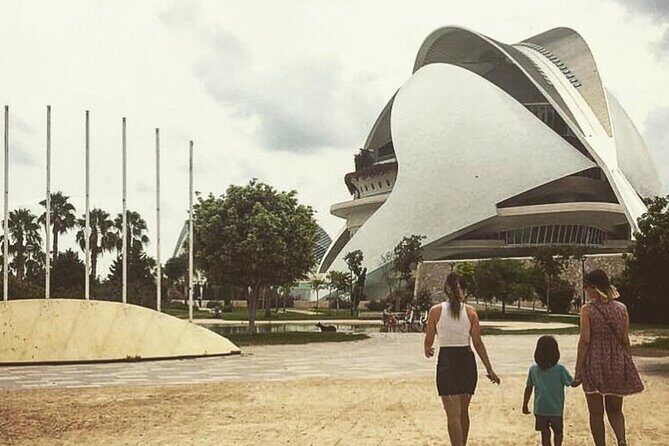
- Exterior-only route means you’ll spend your time on the buildings’ forms, not ticket lines inside.
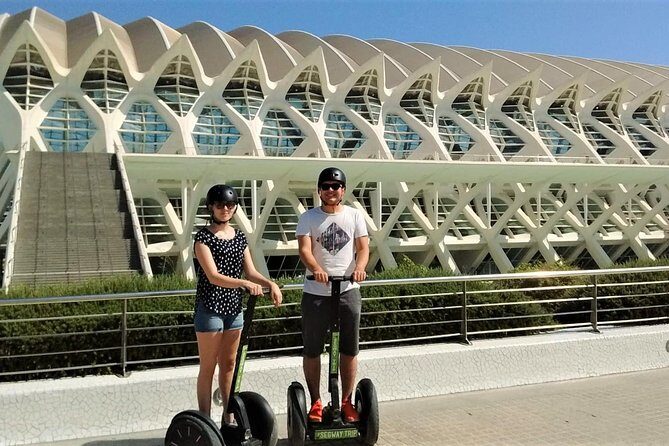
- Calatrava-inspired stops cover Hemisfèric, the Science Museum, Oceanogràfic, Palau de les Arts, and Umbracle views.
- Private guide storytelling helps you understand purpose, not just appearances (many guides mention design intent and construction logic).
- Mobile ticket for check-in adds convenience.
- Ends where you start, so you don’t have to solve a transfer puzzle at the end.
- Admission not included, so decide up front if you want to add interior visits later.
Why Valencia’s City of Arts and Sciences works best as an exterior tour
This complex is famous for what it looks like, but that’s only half the point. The other half is how the buildings behave as objects—structures shaped to fit light, water, movement, and the idea of science as culture. With an exterior-focused format, you spend less time switching between exhibits and more time seeing how the whole place connects visually.
I like this approach because it’s efficient. In a compact time window, you get the “big shapes” you’ll want to photograph and the context you’ll remember later—what each building is meant to do and why the design looks the way it does.
The trade-off is also clear: you won’t automatically go inside anything as part of this tour. If you’re the type who always wants the museum or aquarium floor, you’ll need to plan that separately (or ask whether an interior add-on is possible).
You can also read our reviews of more walking tours in Valencia


The Hemisfèric start: an eye-shaped landmark and a water reflection trick
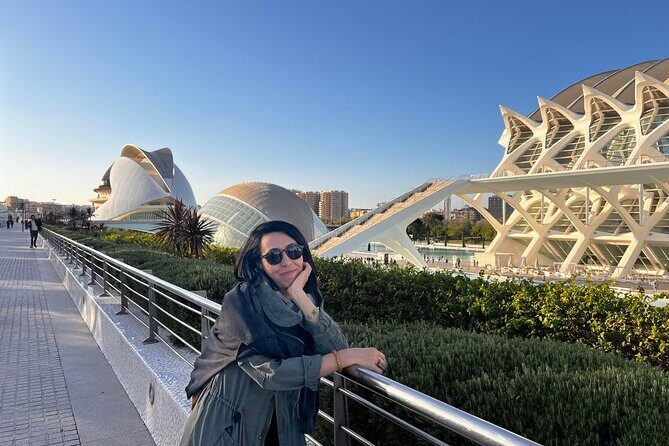
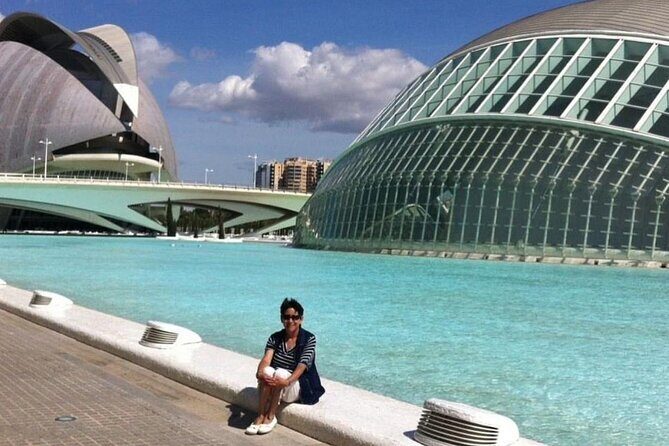
Your tour begins at the Hemisfèric, with its iconic eye-shaped design. The standout detail here is how it reflects in the surrounding water—an effect that makes the building feel less like a static monument and more like a living piece of the complex.
From a design point of view, this is a smart first stop. It gives you a visual anchor early, so the rest of the buildings aren’t just random futuristic shapes. When a guide points out the symbolism of Valencia’s forward-looking vision, the architecture starts to feel like a story with chapters.
Practical tip: if you want photos, arrive ready with your camera settings and a simple plan for reflections. This is one of those spots where timing matters, and the tour structure helps you not waste time hunting angles.
Príncipe Felipe Science Museum: the whale-skeleton silhouette
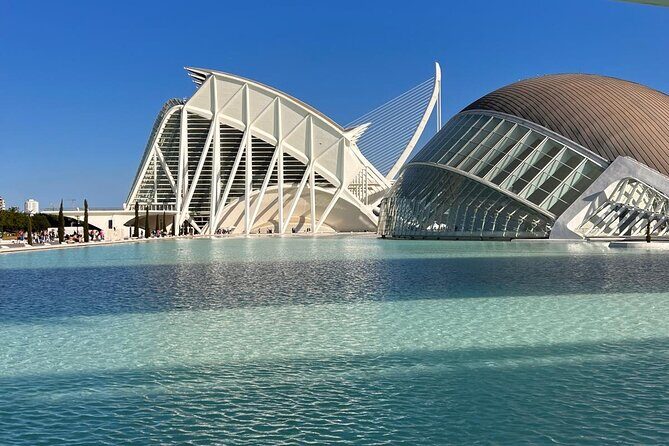
Next up is the Príncipe Felipe Science Museum, known for its unusual architectural form—described as resembling a whale’s skeleton. That comparison matters because it explains why the building feels both organic and technical. You’re not just looking at a shell; you’re looking at a structure designed to communicate “science meets imagination.”
This stop is where a strong guide can really earn their pay. In multiple accounts, guides highlighted not only how the design looks, but how the building’s purpose ties back to the engineering idea behind it. The result: even if you’re not a science-gadget person, the architecture reads more clearly.
Possible consideration: the museum’s interiors aren’t part of this experience. So if you expected hands-on exhibits as part of the visit, you’ll likely feel the gap unless you plan an additional stop on your own.
Oceanogràfic stroll: Europe’s biggest aquarium, seen as sculpture
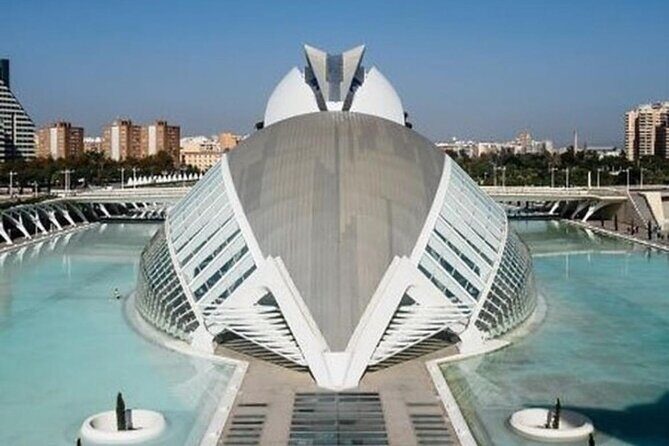
Then you move around the Oceanogràfic, which is described as the largest aquarium in Europe. Here, the exterior focus is actually perfect. The complex is shaped with sleek, organic forms inspired by the sea, and you can see that design language as you walk the area—like waves translated into architecture.
If you care about how buildings imitate nature, this stop clicks. The forms aren’t decorative afterthoughts; they’re part of the way the complex relates to water, animals, and the idea of ecosystems. A guide’s explanation helps you notice the cues you might otherwise miss.
A practical note: because this is an exterior route, you won’t get aquarium-level access in this tour. But you can still get a strong sense of scale and design style, and that often makes a future interior visit more satisfying.
Palau de les Arts Reina Sofía: performing-arts architecture with flowing lines
The Palau de les Arts Reina Sofía is next, and the design is described as flowing and sculptural. That matters because it tells you what to look for: the building doesn’t try to look like a boxy theater. Instead, it behaves more like a piece of performance—shapes that suggest movement and emotion.
This is another place where guide narration tends to raise the experience. People repeatedly mention that their guides connected the architecture to the performing arts purpose, so the building’s curves and structure feel like they’re doing a job, not just looking unusual.
One small consideration: if performing arts venues are your thing, you’ll probably want to check whether there’s a specific event or whether an interior visit can be added elsewhere. This tour keeps you outside, so it’s about understanding the shell and the concept.
You can also read our reviews of more city tours in Valencia






Umbracle viewpoints: garden + walkway views that organize the whole complex
Finally, you reach the Umbracle, a garden and walkway built for panoramic views of the entire Ciudad de las Artes y las Ciencias complex. This is a great closing stop because it changes how you see everything.
Earlier, you’re reading buildings up close. At Umbracle, you step back and the whole design plan makes sense—how the structures relate to each other, how the complex sits in its environment, and how the “future Valencia” theme plays out across multiple functions.
This stop also helps with practical planning: once you’ve seen the whole complex from above and from a walkway, you can decide what you might want to revisit later, either for photos or for an interior add-on.
Price and value: is $139.03 per person worth it?
$139.03 per person is not a budget price, so you want to ask: what do you get that you can’t get alone?
Here’s the value logic:
- You’re paying for a private guide, which means you’re not just walking the grounds—you’re getting targeted explanations about design and purpose.
- The time is compact (about 2 hours), so you’re less likely to wander or miss the best visual angles.
- The tour’s exterior-only structure is efficient. It can help you orient yourself quickly if you’re short on time or you’re pairing this with other plans in Valencia.
The price is also easier to judge because some costs are not included. Admission for interiors isn’t included, and transportation isn’t included. If you expected to pay once and do everything inside, this isn’t that kind of tour.
Still, if you’re an architecture fan—or simply someone who likes learning while walking—this is a smart way to see the complex without needing to become an amateur architectural historian first.
Timing and pacing: a 2-hour walk that keeps the story moving
About 2 hours is the right amount of time for a place like this, as long as you come with expectations. This isn’t a slow, sit-down tour, and it’s not a full-day ticket plan either. It’s a guided circuit built to cover the main buildings and help you understand what you’re looking at.
The fact that it ends back at the meeting point is underrated. You don’t have to calculate a return route or hunt for transport right after you’re done. It’s a small convenience that makes the outing feel “contained,” especially if you’re juggling lunch or another museum later.
Photo tips that match what the tour is built for
This complex is made for photos, but not every stop is equal. If photo-taking is your goal, focus your effort where the architecture has built-in visual tricks:
- Hemisfèric reflections: this is where water and shape do the work for you.
- Science Museum form: the whale-skeleton idea often looks best from a bit of distance, so let the guide’s route timing help you.
- Oceanogràfic organic shapes: move as you walk the exterior so you catch changing angles, not just one front view.
- Umbracle panoramas: use this as your “map moment,” then decide what needs a closer look later.
Bring comfortable shoes. You’ll be walking around a large, open complex, and you’ll enjoy the tour more if you’re not constantly adjusting your feet.
Who this tour suits best (and who should consider other options)
You’ll get the most from this tour if:
- you care about modern architecture and want to know what drives the design choices
- you like a guided route that helps you organize your visit
- you have limited time in Valencia but still want the headline experience
You might want a different plan if:
- you specifically want interior access to the museum/aquarium/theater spaces as part of the main outing
- you’re hoping transportation is included
If you’re doing Valencia in layers—history one day, modern design another—this fits nicely. It gives you a clear contrast to the older streets without turning your day into an endurance test.
Should you book this City of Arts and Sciences private architecture tour?
I’d book it if you’re excited by architecture as much as you’re excited by sightseeing. The exterior-only format is actually a strength here: it keeps the focus on the shapes, the symbolism, and the layout of the complex, and it does it with a private guide who can explain design and purpose as you go.
Skip it or plan differently if interior time is your top priority. Since admission isn’t included and interiors aren’t part of the tour, you’ll need to add that on your own if you want the full museum or aquarium experience.
One last planning thought: this tour often gets booked in advance (about 46 days on average). If your dates are set, grabbing it early can help you lock in a time that fits your Valencia schedule.
FAQ
How long is the Valencia City of Arts and Sciences private walking tour?
It lasts about 2 hours.
Is this tour private?
Yes. It’s a private tour, and only your group participates.
What part of the complex does the tour cover?
The focus is on exterior visits only, including Hemisfèric, the Príncipe Felipe Science Museum, Oceanogràfic, Palau de les Arts Reina Sofía, and Umbracle.
Are building interiors included?
No. Interior visits are not included, and the admission ticket is not included. You can ask the local agency if an interior add-on is available.
Is transportation included?
No. Transportation is not included.
Where do we meet the guide?
The meeting point is Barceló Valencia, Av. de França, 11, Camins al Grau, 46023 València, Valencia, Spain.
Does the booking use a mobile ticket?
Yes. The tour includes a mobile ticket.
Is the admission ticket included in the price?
No. Admission tickets are not included.
What is the cancellation policy?
You can cancel for a full refund up to 24 hours in advance of the experience start time.
Is it suitable for most travelers, and are service animals allowed?
Most travelers can participate, and service animals are allowed. The meeting point is also near public transportation.
If you tell me your travel dates and whether you want any interior visits added, I can help you decide if this exterior-only tour is the best first step for your schedule.