REVIEW · VALENCIA
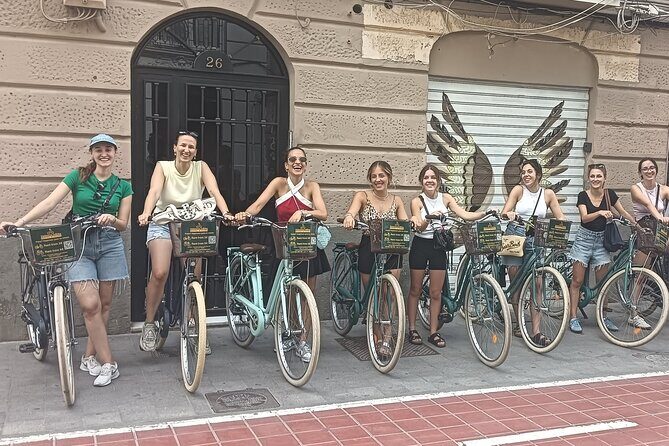
Valencia (Ruzafa): Guided Bike Tour of the city’s highlights.
Book on Viator →Operated by ValenciaInBike · Bookable on Viator
Valencia on a bike feels like a shortcut through time. You’ll cover the old city core and the modern City of Arts in about 3 hours, with stops that range from a 19th-century bullring to UNESCO-grade Gothic trade power. I love that the route is built around major landmarks without turning the day into a slow march.
Two standout perks for me: the tour guide delivery (people rave about how clear and informative it is, including guide Martin) and the fact that the ride is easy thanks to electric bikes, so you’re not arriving tired at the next photo spot. One thing to keep in mind: the tour is English and the stops are packed, so you’ll want to be ready for a brisk pace and some admission areas that cost extra.
In This Review
- What you’ll get from this Valencia highlights ride
- Ruzafa’s bike route: how you see more without suffering
- Your bike and pacing: easy riding, timed stops
- Plaza de Toros: neo-Mudejar bullring energy (and more than bullfights)
- Quart Towers: medieval gate views you can’t fake
- Mercado Central: the best way to read Valencia through food
- La Lonja de la Seda (UNESCO): trade power in civil Gothic stone
- Plaza de la Virgen (Placa de la Mare de Deu): where the city meets
- Valencia Cathedral and El Micalet: Gothic meets Baroque and the view reward
- Centre Arqueològic de L’Almoina: Roman Valencia under modern feet
- Plaza de la Reina: your photo break with Cathedral-and-tower framing
- Palau de Benicarló (Borgias) and the Cortes Valencianes courtyard
- Torres de Serranos: medieval city walls with a view payoff
- Jardín del Turia: the green ribbon, bridges, fountains, and whimsy
- Ciudad de las Artes y las Ciencias: modern Valencia in science-mode
- Price and value: what $36.01 buys you (and what it doesn’t)
- Guide quality: clear storytelling matters on a packed route
- Who should book this bike tour (and who might not love it)
- Should you book this Valencia (Ruzafa) guided bike tour?
- FAQ
- How long is the Valencia guided bike tour?
- How much does it cost?
- What language is the tour offered in?
- Is there a ticket for every stop?
- Do you visit Mercado Central inside?
- Where is the meeting point, and does the tour end nearby?
- How many people are in the group?
- What should I do if the weather is bad?
- Is free cancellation available?
What you’ll get from this Valencia highlights ride
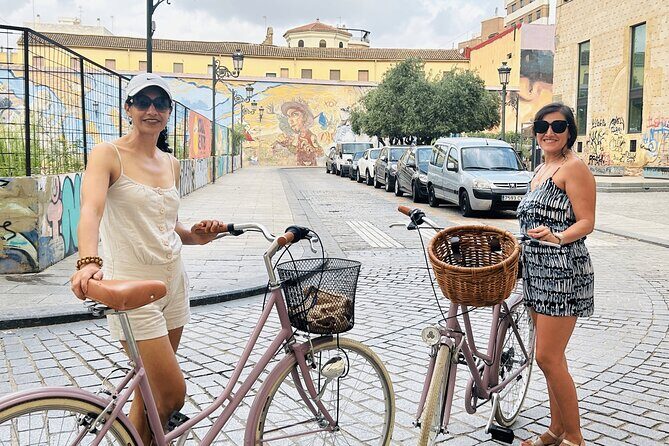
- Electric-assisted city bikes make the distances feel manageable.
- A guide-led loop that mixes medieval, Roman, and modern Valencia.
- Market + UNESCO stops (Mercado Central and La Lonja de la Seda) with great context.
- A classic view-finisher at Torres de Serranos and the Turia park system.
- A modern architectural finale in the City of Arts and Sciences complex.
- Small-group feel with a maximum of 15 travelers.
Ruzafa’s bike route: how you see more without suffering
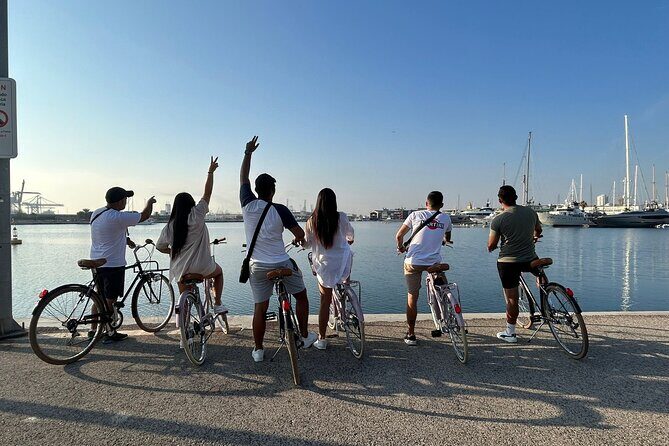
This tour is built for motion. You’ll spend real time outdoors, but not in the exhausting way that can happen when a route is mostly transfers and no momentum. The ride time between locations is about 1.5 hours, and the rest is made up of guided stops—short, focused, and designed so you don’t miss the story behind each place.
I like this format because Valencia rewards knowing what you’re looking at. The city has layers—Roman bones, medieval walls, and today’s futuristic architecture—and the bike gives you the chance to collect those layers in one afternoon. You’ll also come back to your starting area, so it feels more like a loop than a one-way scramble.
The group size is capped at 15, which helps the guide keep an eye on everyone and keep explanations flowing. If you’ve ever been on a tour where you constantly lose the group, this is the opposite vibe.
You can also read our reviews of more cycling tours in Valencia
Your bike and pacing: easy riding, timed stops
The tour uses comfortable city bikes, and the ride is described as electric-assisted in guest feedback. That matters in Valencia because the city streets can include small pushes and turns that add up. With electric support, you can keep your energy for the stops—especially around the denser old-town areas and when you’re trying to get quick photos.
A practical note: the day isn’t a sit-on-a-promenade-and-stare plan. You’ll be moving between sights, then pausing long enough for a guided walkthrough and a couple of minutes to look around. If you prefer slow wandering and long museum stays, you might find the schedule a bit tight.
That said, it’s ideal for first-time visitors who want the big landmarks and the basic map of how Valencia is organized.
Plaza de Toros: neo-Mudejar bullring energy (and more than bullfights)
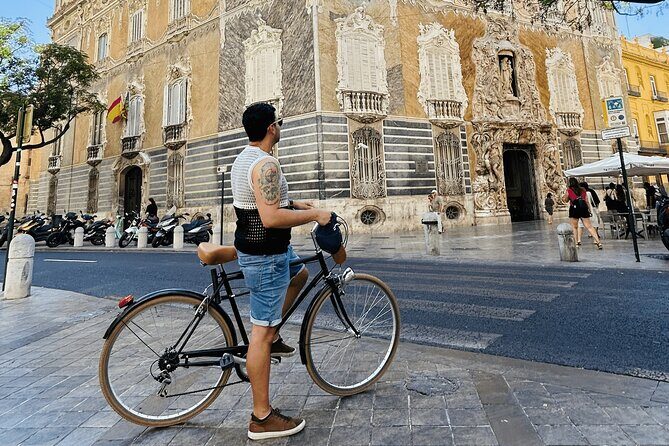
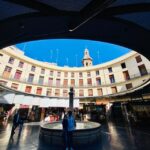
Stop one is the Plaza de Toros, a major Valencia symbol built in the 19th century. Even if you’re not here for bullfighting, this place is worth the first-stop energy because the structure itself tells a lot about the city’s identity.
What I’d pay attention to:
- The neo-Mudejar architecture, which gives the building a distinctive, decorative style.
- The scale and atmosphere of the arena space—this is the kind of structure you notice even from the sidewalk.
The stop is short (about 5 minutes), and admission is free for this stop. That makes it a perfect opener: you get oriented fast, then you roll on before the pace drains your attention.
Possible drawback: because the stop is quick, you won’t get a deep architectural walkthrough here unless you ask questions while everyone’s stopped.
Quart Towers: medieval gate views you can’t fake
Next up are the Quart Towers—one of the few medieval defensive towers still standing from the 15th century. The walls show battle marks, including impacts from artillery, and the views from the top are the kind that make you understand why cities built forts in that spot.
This stop lasts about 10 minutes, with free admission. Here’s what to do with your time:
- Look for the visible signs of conflict in the tower structure.
- Use the viewpoint moment to locate where you are relative to the old town.
This is one of those stops where a quick guide explanation changes everything. Without context, it’s just a tower. With it, it becomes a survival map of the city.
Mercado Central: the best way to read Valencia through food
Then you hit the Central Market of Valencia. This is the culinary heart of the city, and the stop includes an internal visit from Monday to Saturday morning. If you’re going on another day, you may just see how the area functions from outside, so check your tour date expectations.
This is where senses take over: colors, smells, and the constant flow of people and produce. Even in short time, you get the feeling that Valencia eats well and loudly.
It’s also a smart pairing in the overall route. After the towers and bullring, the market gives you something human and everyday to ground the city stories.
The stop is about 30 minutes and admission is free for the market visit.
Practical tip: If you want to buy snacks, bring a little cash or card ready. The tour doesn’t specify planned tastings, so you’ll rely on what’s available in the market itself.
You can also read our reviews of more guided tours in Valencia




La Lonja de la Seda (UNESCO): trade power in civil Gothic stone
La Lonja de la Seda is a UNESCO World Heritage Site and one of Valencia’s most impressive civil Gothic monuments. This building was tied to the city’s golden age of trade, and that’s exactly the lens your guide should give you—because it helps you see why this isn’t a church.
Expect tall columns, sharp architectural details, and a sense of order and calculation in the design. The stop is about 10 minutes, but admission is not included, so you’ll have to pay if you want to enter fully.
Why this stop is valuable on a bike tour: you get the explanation fast, then you can decide on the spot if you want the full interior time. If you’re not into architecture, you can at least appreciate the exterior scale and the feel of the space.
Plaza de la Virgen (Placa de la Mare de Deu): where the city meets
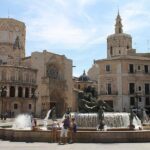
The tour swings into Plaza de la Mare de Deu (often called Plaza de la Virgen), which is basically the pulse point of Valencia life. This is where history and daily routines sit side by side.
You’ll see:
- The basilica setting around the square
- The famous Turia fountain
- A natural meeting point for locals
This stop lasts about 15 minutes and is free. It’s one of the best breaks in the route—enough time to pause, look around, and feel the rhythm without sprinting again immediately.
Small consideration: because it’s central and popular, it can be crowded around peak times. That’s not a fault of the tour, just reality.
Valencia Cathedral and El Micalet: Gothic meets Baroque and the view reward
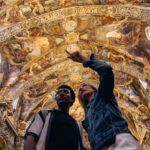
Next is Valencia Cathedral, an architectural mix of Gothic, Baroque, and Renaissance styles. The big reason people care is what’s inside: the Holy Grail is among the most venerated Christian treasures here.
You’ll also get to think about the skyline because the cathedral’s bell tower, El Micalet, is famous for views. The stop is about 10 minutes, and admission isn’t included here. So if you want to go inside or climb for the full viewpoint, budget extra.
Why I think this works on a bike tour: you can get the visual wow immediately, but you’re not forced into a ticketed time sink. You choose how much deeper you want to go based on your energy.
Centre Arqueològic de L’Almoina: Roman Valencia under modern feet
If you like your city stories layered, this stop hits the spot. The Centre Arqueològic de L’Almoina reveals Roman origins of Valencia. You’re looking at remains of ancient streets and buildings and Roman baths that date back over 2,000 years.
This is one of those stops that feels quieter and more reflective than the main square areas. The tour time is about 8 minutes, and admission isn’t included.
Practical angle: since time is limited, focus on what the guide points out—how the Roman layout relates to the city you see today. Even a short stop can change how you walk Valencia later.
Plaza de la Reina: your photo break with Cathedral-and-tower framing
Plaza de la Reina is one of the most photographed spots in Valencia for a reason: it offers a strong view setup for the cathedral and the El Micalet bell tower.
This stop is about 10 minutes and free. It’s ideally placed after a couple of heavier architecture stops. You get an easy breather, a chance to grab photos, and time to reset.
If you’re the type who likes to sit for two minutes before moving again, this is that spot. Cafés and shops are around, so you can also decide if you want a quick drink while the group gets ready to ride.
Palau de Benicarló (Borgias) and the Cortes Valencianes courtyard
Then you roll into Palau de Benicarló, also known as the Palace of the Borgias. It’s a Renaissance building that served as the residence of the influential Borgia family in Valencia and today houses the Cortes Valencianes, the regional parliament.
Admission isn’t included for this stop, and the time is short (about 5 minutes). Still, it’s a worthwhile political-and-aristocratic history break because it changes the usual “palaces are just pretty” story.
What to look for:
- The feel of the Renaissance courtyard space
- The contrast between grand nobility and modern governance in the same setting
This is a “glance and learn” stop. If you want deeper access, you’d likely need additional time outside the tour.
Torres de Serranos: medieval city walls with a view payoff
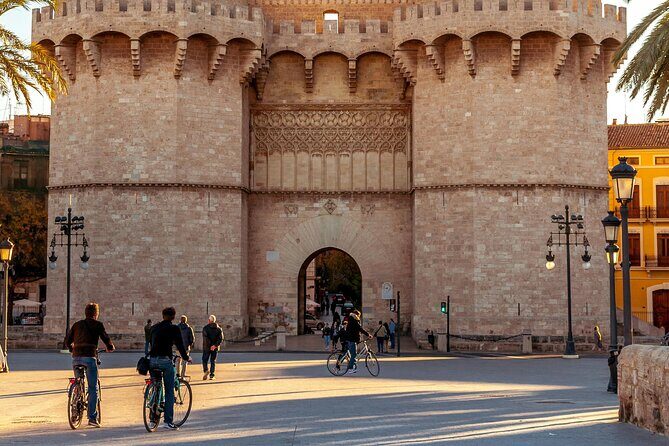
Torres de Serranos are one of Valencia’s most iconic landmarks and among the best-preserved medieval gates in Europe. Built in the 14th century, they were part of the city walls and a key defensive structure.
The stop lasts about 10 minutes and is free. It’s also a view-friendly stop, letting you look back at the old town and see how the Turia river shapes the city’s layout.
This is a strong “closing the old town story” point in the route. After you’ve seen the bullring, towers, cathedral area, and plazas, Serranos gives you the defensible city perimeter—literally the boundary that shaped everything inside.
Jardín del Turia: the green ribbon, bridges, fountains, and whimsy
Now you shift to the Turia Gardens, Valencia’s long green park that runs through the city. This is the route where biking starts to feel like cruising, even though you’re still moving.
Along the way, the tour highlights several famous pieces:
- Calatrava Bridge, a futuristic design moment
- Flower Bridge, covered with plants that change with each season
- Palau de la Música, with its auditorium setting among fountains and gardens
- Gulliver Park, with the gigantic Gulliver sculpture-game from Gulliver’s Travels
This stop is about 20 minutes and free. For me, it’s one of the most memorable stretches because it shows how Valencia turns space into culture and play, not just “park time.”
Practical consideration: because the gardens are long and busy, you’ll want to stay aware of where the group is heading. This isn’t a “wander and stop whenever” environment.
Ciudad de las Artes y las Ciencias: modern Valencia in science-mode
The grand finale is the City of Arts and Sciences complex—futuristic architecture that mixes science, art, and nature in one designed environment. The tour includes:
- Palau de les Arts Reina Sofía, for opera and classical performances
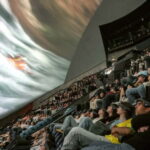
- Hemisférico, which hosts an IMAX cinema, planetarium, and laser space
- Museo de las Ciencias Príncipe Felipe, an interactive science museum
- Ágora, a multifunctional event space
The stop time here is about 30 minutes, and admission is not included (as indicated for Ágora). That means you’ll likely be seeing the complex and parts of the exterior or common areas, unless you decide to pay extra at individual venues.
This ending works because it contrasts sharply with the medieval and Roman stops earlier. You finish with the feeling that Valencia doesn’t preserve its past by freezing time—it builds on top of it.
Tip: if your interests are science-heavy (planetarium/IMAX), this is where you’d probably want to extend on your own after the tour.
Price and value: what $36.01 buys you (and what it doesn’t)
At about $36.01 per person for roughly 3 hours, this tour is priced like a high-value highlights sampler. You’re getting a guided route with multiple major sights, a bike, and a structure that helps you connect the dots between eras.
What you should budget for: several stops list admission as not included, including La Lonja de la Seda, Valencia Cathedral, the Almoina archaeological site, and the Palau de Benicarló. In other words, the tour is great for orientation and learning, but it doesn’t automatically cover every “go inside” moment.
Also worth noting: the tour uses a mobile ticket, which is convenient when you’re juggling multiple bookings in one day. It’s a small thing, but it matters when you’re trying to move through a city fast.
So the value equation is simple:
- If you want a guided overview and you’re fine paying a few entry fees if you choose to go inside, this is a solid deal.
- If you want a fully ticketed, museum-heavy experience with everything included, this may feel a bit extra-cash on top.
Guide quality: clear storytelling matters on a packed route
The biggest recurring praise centers on the guide’s impact. People highlight how informative the explanations are and how much there is to learn along the way. One guide name that pops up is Martin, praised for having excellent knowledge of Valencia.
That’s exactly what you want on this kind of tour. The stops are iconic, but the real payoff is the meaning: why La Lonja looks the way it does, what Quart Towers signaled for defense, what the Roman remnants reveal about the city’s origins, and why the modern City of Arts feels like Valencia’s next chapter.
One caution from lower feedback: organization and the depth of explanations didn’t meet expectations for at least one group, and there was mention of limited Italian. For you, that mostly translates to this: confirm you’re comfortable with the tour language (English) and expect a schedule-first approach rather than a slow “ask anything for an hour” style.
Who should book this bike tour (and who might not love it)
This tour is a strong fit if you:
- Want to see a lot of Valencia in a short window
- Like guided context at each landmark
- Prefer biking over doing everything on foot
- Appreciate a mix of old town sights and the modern City of Arts
You might choose a different option if you:
- Want long museum time or deep interior access at every stop
- Prefer a slower pace with more downtime
- Need explanations in a specific second language beyond English
Should you book this Valencia (Ruzafa) guided bike tour?
Yes, if your goal is a fast, guided highlights route that connects major sites without turning your day into a logistics nightmare. For the money, you’re paying for direction, pacing, and storytelling, plus a comfortable bike ride powered by electric assistance. The itinerary hits the big-name places people come to see: Mercado Central, La Lonja, cathedral area, Serranos, the Turia Gardens, and the City of Arts.
If you’re the type who wants every stop fully entered, add extra budget and time for the places marked as admission not included. And if you’re not comfortable with English, this one may not be the best fit.
If you want a one-day Valencia foundation to build on afterward, this tour gives you exactly that.
FAQ
How long is the Valencia guided bike tour?
It runs for about 3 hours.
How much does it cost?
The price is $36.01 per person.
What language is the tour offered in?
The tour is offered in English.
Is there a ticket for every stop?
Several stops are marked as free, while others are marked as admission not included. Not included examples in the route include La Lonja de la Seda, Valencia Cathedral, the Almoina archaeological site, and the Palau de Benicarló.
Do you visit Mercado Central inside?
There is an internal market visit on tours from Monday to Saturday morning.
Where is the meeting point, and does the tour end nearby?
You meet at C. de Cuba, 24, L’Eixample, 46004 València, Spain. The tour ends back at the meeting point.
How many people are in the group?
The tour has a maximum of 15 travelers.
What should I do if the weather is bad?
The experience requires good weather. If it’s canceled due to poor weather, you’ll be offered a different date or a full refund.
Is free cancellation available?
Yes. You can cancel for a full refund up to 24 hours in advance of the start time.